
How Search Behaviour Is Changing in the Age of AI
AI tools are not replacing search overnight - but they are changing how people research, compare, and choose businesses before they ever click a website.
Can AI Understand Your Business?
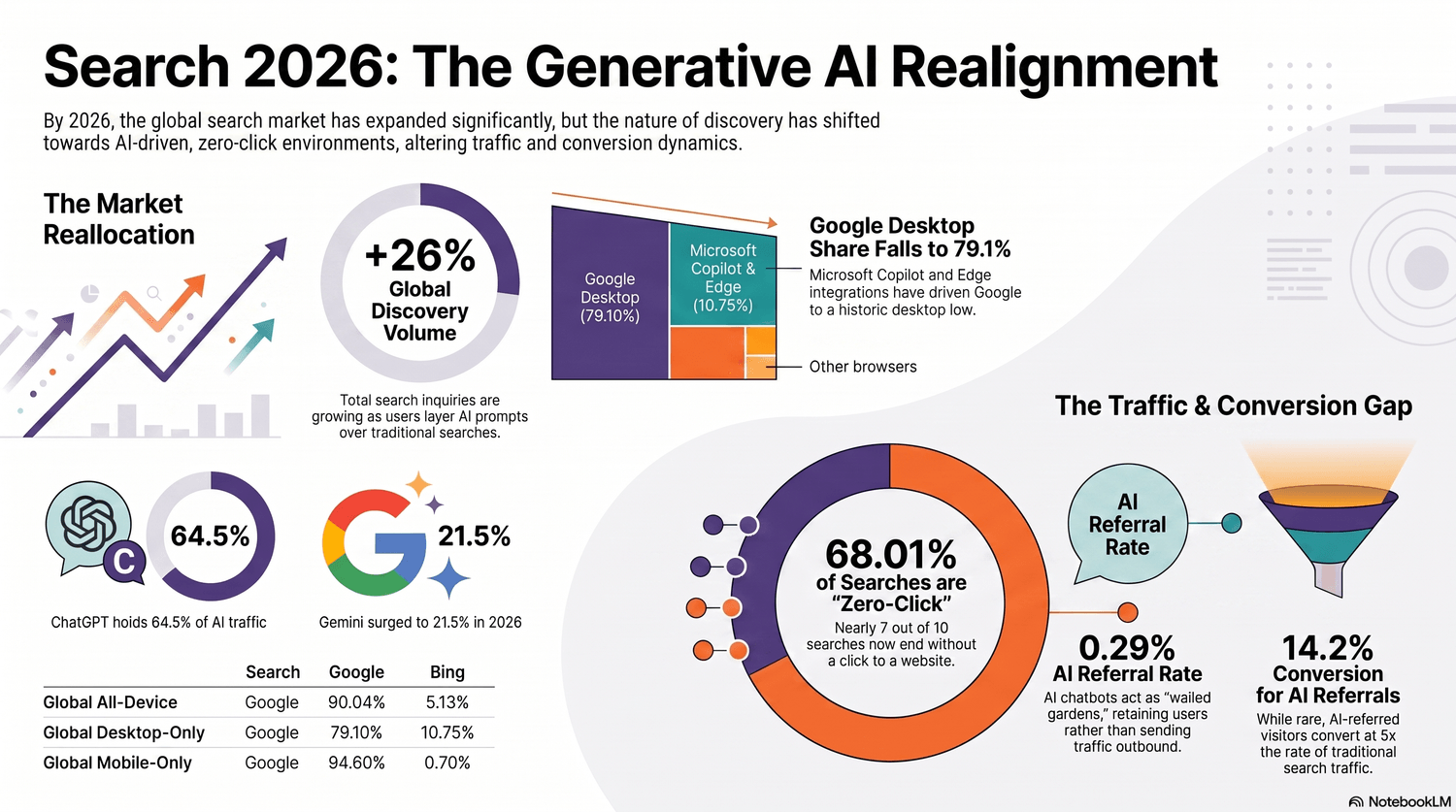
The way people find information online is changing. For years, search meant typing a few words into Google, scanning a list of links, and choosing the result that looked most useful. That still happens every day, especially when people are looking for a specific business, map listing, product, phone number, address, or review.
But it is no longer the whole picture. More people are now asking longer, more specific questions inside tools such as ChatGPT, Google Gemini, Microsoft Copilot and Perplexity. At the same time, Google is placing AI-generated summaries directly inside search results. This means many people are getting an answer before they ever click through to a website.
For local businesses, this does not mean Google is dead. It means visibility is becoming broader. A business now needs to be clear enough for humans, search engines and AI systems to understand what it does, who it helps, where it works and why it should be trusted.
The old search journey was built around clicks
Traditional search was built around a simple exchange. A person searched. Google showed a page of possible answers. Websites competed for those clicks through SEO, paid ads, local listings, reviews, backlinks and content.
That model still matters. Google continues to dominate search activity globally and in Australia. Search engines remain especially important for local intent, where people want directions, opening hours, phone numbers, service areas, product availability or a nearby provider.
The change is that many searches are now becoming answer-first rather than link-first. Instead of showing only a list of websites, search platforms are increasingly summarising the answer on the page. AI tools go one step further by turning the search process into a conversation.
The new behaviour: people ask complete questions
When people use AI tools, they tend to ask questions differently. They are less likely to type short keyword phrases such as “best accountant Brisbane” and more likely to ask something like, “Who is a good accountant on Brisbane’s northside for a sole trader who needs help with BAS, tax planning and Xero?”
That shift matters because the AI system is not just matching keywords. It is trying to understand intent, compare options, summarise information and give a confident answer. It may draw from websites, business profiles, reviews, directories, articles, forum discussions, structured data and other public signals.
This creates a new kind of visibility challenge. It is not enough to have a website that says “quality service” and “contact us today”. AI systems need clear details. They need context. They need evidence. They need to understand the business as an entity, not just a collection of pages.
Google is still important, but the search results page has changed
Google is still the main search platform for most people. That is especially true on mobile devices, where people often search while they are out and ready to act. But the results page is changing. Google’s AI Overviews can provide a summarised answer at the top of the page, often before the traditional organic results.
Research from Pew Research Center found that people were less likely to click through to other websites when a Google AI summary appeared. In its March 2025 analysis, users clicked a traditional search result in 8% of visits where an AI summary appeared, compared with 15% of visits where no AI summary appeared.
That does not mean website traffic disappears completely. It means some informational clicks are being compressed. People may get the basic answer from the search page itself. The websites that still win attention are often the ones that provide clearer, deeper, more useful or more trusted information than a basic summary can provide.
Zero-click search is becoming normal
Zero-click search happens when someone searches but does not click through to another website. This can happen because they found the answer in a map pack, featured snippet, knowledge panel, AI summary, business profile, calculator, weather box, review panel or other search result feature.
SparkToro’s 2026 zero-click study reported that less than one third of Google searches were sending a click to the open web in the first four months of 2026. Whether every business feels this equally depends on the industry, location, query type and strength of the business’s brand. But the direction is clear: measuring success only by website clicks is becoming too narrow.
For a local business, visibility now includes being seen, understood and trusted across multiple places, even when the customer does not immediately land on the website. That includes Google Business Profile, reviews, service pages, local directories, social proof, articles, FAQs and the way the business is described across the web.
AI search is strongest for research, comparison and explanation
AI search is especially useful when people want help thinking through a decision. They may ask for comparisons, recommendations, checklists, pros and cons, questions to ask, or a shortlist of providers. This is different from a simple “near me” search, but it can still influence who gets considered.
For example, a local customer might ask an AI tool: “What should I look for when choosing a builder for a small renovation?” or “Which local services usually help a new café get found online?” The answer may not produce an immediate click, but it can shape what the customer believes, which businesses they trust, and which names they search for next.
This is why authority content matters. Helpful pages that explain topics clearly can support both human trust and AI understanding. They give search engines and AI systems more context about what your business knows, how it helps, and the types of problems it is relevant to.
For businesses, the goal is no longer just rankings
Traditional SEO usually focused on rankings: can your page appear near the top of Google for a target keyword? Rankings still matter, but they are no longer the full picture.
The newer goal is visibility across the whole discovery journey. That includes whether your business appears in local search, whether your website clearly explains your services, whether reviews confirm your claims, whether your content answers real customer questions, and whether AI tools can understand and summarise your business accurately.
This is why many marketers now talk about AI visibility, answer engine optimisation, generative engine optimisation, or share of model. The names differ, but the core idea is simple: make your business easier for answer systems to understand, trust and recommend.
What AI systems need to understand about a local business
Most local business websites are written for people, but many are still too vague for machines. They say things like “we provide professional solutions” or “we offer quality service”, but they do not clearly state the practical details that help a customer, search engine or AI tool understand the business.
A strong local business website should make the basics obvious: who you help, what services you provide, where you work, what problems you solve, what makes you different, what proof you have, and what someone should do next.
This does not mean stuffing pages with keywords. It means using clear, specific language. A page that says “we help homeowners in North Lakes, Redcliffe and surrounding Moreton Bay suburbs with blocked drains, hot water repairs and emergency plumbing” gives search systems much more usable information than a generic sentence about “fast, reliable plumbing services”.
The role of reviews, directories and third-party mentions
AI systems do not only look at what a business says about itself. They can also be influenced by what other sources say. Reviews, directories, local mentions, industry profiles, social proof, comparison sites and community discussions can all help build a clearer picture of a business.
In B2B software, G2’s 2026 AI Search Insight Report found that AI chatbots have become a major influence on buyer shortlists. While local services are different from software buying, the broader lesson still applies: third-party credibility signals matter. AI-generated answers often rely on external proof, not just a company’s own marketing copy.
For local businesses, that means reviews, accurate listings, consistent business details and clear public information are not just “nice to have”. They help confirm that the business is real, relevant and trusted.
What this means for small businesses
Small businesses do not need to panic or chase every new AI trend. The practical response is much simpler: make the business easier to understand everywhere it appears online.
That starts with the website. Service pages should be specific. Location details should be clear. FAQs should answer the questions customers actually ask. About pages should explain the business in plain English. Reviews and proof should support the claims being made. Contact details, opening hours and service areas should be consistent across the web.
The businesses most likely to benefit from AI search are not necessarily the biggest. They are often the clearest. If a smaller local business explains its services better than a larger competitor, has stronger proof, and makes its location and customer fit obvious, it gives both people and machines more to work with.
A practical AI visibility checklist
A local business is in a stronger position when its online presence clearly answers these questions:
Who do you help?
What exact services or products do you provide?
Where do you provide them?
What problems do customers usually come to you with?
Why should someone choose you over a similar provider?
What proof supports your claims?
Are your business name, address, phone number and website details consistent across key platforms?
Do your pages answer common customer questions in plain English?
Are your reviews recent, specific and easy to find?
Can someone quickly understand what to do next?
Conclusion
Search is not disappearing. It is being reshaped. People still use Google. They still click websites. They still check reviews. They still ask friends. But they are also asking AI tools for explanations, comparisons and recommendations.
For small businesses, this creates a clear opportunity. The businesses that explain themselves properly online will be easier for customers to choose and easier for AI systems to understand. The businesses that stay vague may become harder to recommend, even if they offer a good service.
The practical goal is simple: become clearer, more useful and more trustworthy online. That is the foundation of AI search visibility.
Plain-English takeaway: AI search visibility is not about tricking AI. It is about making your business clearer, more specific and easier to trust across your website, listings, reviews and helpful content.

About the Author
Nathan Ferguson
As an AI implementation consultant and the founder of iBuildLocal, Nathan specializes in practical AI for business. He helps local companies optimize their AI search visibility so they get recommended by modern answer engines and AI search tools.
Connect with Nathan on LinkedIn
Transparency Note: This article was researched and written by Nathan Ferguson in collaboration with AI tools, utilizing the exact AI optimization and clarity frameworks we build for our clients.

Want to know how clearly AI tools
understand your business?
Request a Free Al Vislbility Report from iBuildLocal and get a plain-English review of
what is clear, what may be missing and what could be improved.